


|
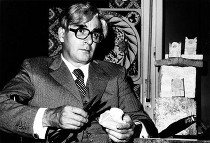
Bogdan Bogdanović *20.08.1922 in Belgrad † 18.06.2010 in Vienna born in Belgrade into a family of left-wing intellectuals 1940 finished school, began studying architecture at the Technical Faculty of Belgrade University 1941 during the German occupation he dedicated himself to reading and earned his living by giving extra lessons to schoolchildren 1944/45 participated in the war as a Partisan, and was seriously injured in east Bosnia 1950 graduated as an architect from the Technical Faculty in Belgrade with the urban plan for the island of Lopud near Dubrovnik 1952 completed his first building, the Memorial to the Jewish Victims of Fascism in Belgrade 1953 completion of the housing estate of the Jaroslav Černi Institute of Hydro Technology at the foot of Avala mountain near Belgrade; subsequently developed numerous urban development concepts in abstracto; received a permanent assistant post at the Chair for Urban Development 1958 published his first book: Mali urbanizam (Small Urbanism) 1960 docent, Chair for Urban Development 1962 held his first series of lectures at the Technical Faculty in Belgrade: 'The Development of Forms of Settlement', later 'The History of the City' 1964 associate professor, Chair for Urban Development 1964/65 three month stay in Paris; research at the Bibliothèque Nationale and a course on the revitalisation of small historic towns 1964–68 president of the Yugoslavian Architects Association 1967 divorce of second marriage, and marriage to Ksenija Anastasijević; docent and later professor at the Chair for English at the Philological Faculty of Belgrade University 1969/70 ten-month field trip to university libraries in the USA (Madison/Wisconsin and Columbus/Ohio) 1970 corresponding member of the Serbian Academy of Sciences and Arts; dean of the Architecture Faculty 1971/72 his attempt to modernise architecture training according to the principles of a grassroots democracy failed due to the resistance of his colleagues and the dogmatic wing of the Communist Party; resigned his post as dean following the changes of political leadership in Serbia (the overthrow of the so-called 'Liberals') 1973 tenured professorship, introduced the course 'Symbolic Forms'; Menção Honrosa Prize at the São Paulo Biennial 1976 moved his 'Symbolical Forms' course into an abandoned village school in Mali Popović, near Belgrade, where he spent the following years running an alternative workshop on architecture philosophy 1981 resigned from the Serbian Academy of Sciences and Arts 1982–86 held office as the mayor of Belgrade 1985–86 organised and supervised an international competition for the new regulation of Novi Beograd 1987 published an anti-nationalist and anti-military open letter to Slobodan Milošević and the Central Committee of the Serbian Communist Party; founding member of the International Academy of Architecture IAA in Sofia; conferral of emeritus status 1989 Piranesi Prize in Piran (Slovenia) 1990 banned from the village school in Mali Popović 1991–92 during the war in Croatia and Bosnia-Herzegovina he again made anti-nationalist comments, which led to a malicious campaign against him in the state-owned media and violent assaults on his person 1993 moves to Vienna with his wife Ksenija, on the initiative of his old friend Milo Dor 1994 overseas member of the Russian Academy of Architecture and Building Sciences; begins working on the experimental project for a monument on the Weg des Friedens on the Vienna Donauinsel 1995 Die Verteidigung der Stadt (The Defence of the City), exhibition at the Planungswerkstatt Wien in Vienna 1997 Herder Prize from the Alfred Toepfer Stiftung F.V.S. Hamburg 1998 corresponding member of the Bavarian Academy of Fine Arts 2000 corresponding member of the Collegium Europaeum Jenense at the Friedrich-Schiller University, Jena 2001 first trip to Belgrade following eight years of exile 2002 Austrian Cross of Honour for Science and Art, 1st Class 2003 Gold Medal of Honour for services to the state of Vienna 2005 consigned his archive of drawings to the Architekturzentrum Wien Major Buildings Major Buildings Memorial to the Jewish Victims of Fascism, Belgrade, Serbia, 1951–52 Jaroslav Černi housing estate for the Hydro-Technology Institute, Avala near Belgrade, Serbia, 1952–53 Grave for a Fallen Hero of the People's Liberation Struggle, Nova Varoš, Serbia, 1956 Commemorative Cemetery for the Victims of Fascism, Sremska Mitrovica, Serbia, 1959–60 Partisans Necropolis, Mostar, Bosnia-Herzegovina, 1959–65 Memorial for the Victims of the Concentration Camps, Jasenovac, Croatia, 1959–1966 Adaptation of Queen Natalija's villa, Smederevo, Serbia, 1960–61 Slobodište Symbolic Necropolis with open-air stage, Kruševac, Serbia, 1960–65 Cult Site for the Serbian and Albanian Partisans (with Dimitrije Mladenović), Kosovska Mitrovica, Kosovo, 1960–73 Cenotaph for the Fallen Resistance Fighters, Prilep, Macedonia, 1961 Monument to the Revolution, Leskovac, Serbia, 1964–71 Memorial to the Fallen of the Wars of Liberation from 1804–1945, Knjaževac, Serbia, 1969–71 Soldiers Cemetery, Štip, Macedonia, 1969–74 Cenotaph at Garavice Memorial Park, Bihać, Bosnia-Herzegovina, 1969–81 Memorial Site with Soldiers Mausoleum, Čačak, Serbia, 1970–80 Group of Cenotaphs, Bela Crkva, Serbia, 1971 Cenotaphs for the Victims of Fascism, Travnik, Bosnia-Herzegovina, 1971–75 Cult Site for the Fallen Freedom Fighters, Vlasotince, Serbia, 1973–75 Dudik Memorial Park for the Victims of Fascism, Vukovar, Croatia, 1978–80 Soldiers Mausoleum, Popina near Trstenik, Serbia, 1979–81 |
|
 |
|
© Bogdan Bogdanović |
|
Gallery: Blätter aus der Sammlung: „Paradoxe ABCs“ von Bogdan Bogdanović Dates: Book presentation: Den Toten eine Blume Information: Karoline Mayer Tel.: +43 (1) 522 31 15 - 28 Fax: +43 (1) 522 31 17 Email: mayer@azw.at |
| © Architekturzentrum Wien 2026 |
 |
|
|
|
|