


|
Bernard Rudofsky On his 100th Birthday Location: Architekturzentrum Wien - Podium Symposium: 15 April 2005 - 16 April 2005 Tickets: Free entry! Friday 15.04.2005 6.30pm – 7.15pm Maria Welzig, architecture journalist and freelance curator, Vienna Bernard Rudofsky – Viennese Interactions Even if Rudofsky said of himself that he only had "roots in the air, like some rainforest plants", his work nevertheless stands in a specifically Viennese cultural context. Concurring with Adolf Loos and Josef Frank, he saw architectural issues as primarily effecting everyday life, and like Frank – against the technocratic and nationalistic spirit of the time – he took the liberty of using the entire global cultural history as a source of insight and inspiration. This common background also explains the numerous lines of connection to his fellow Viennese architect Roland Rainer. Eventually this circle closed with Rudofsky's return to Vienna as curator of the exhibition Spart/Sybaris at the MAK in 1987: a late discovery for the German-speaking countries of this internationally successful maker of exhibitions and author. Rudofsky equates architecture to the essential questions of life, making his work a timeless and rewarding source. 7.15pm – 8.00pm Andrea Bocco, Politecnico di Torino The Art of Dwelling: Domestic Well-Being, Mediterranean Spirit and Architectural Design His years of residence on the coasts of the Mediterranean follow a century-old tradition among Northern architects and artists and made him live one of the pivotal, albeit ambiguous, phases of Modernism. But, above all, that was the place where to personally live a healthy life, psychophysically wholesome; the warm source of a ”still unspoilt” way of dwelling and living (”Lebensweise”), where it seemed to be possible to explore the themes of the house and clothing down to their roots. Rudofsky publicized the results of these explorations both through his highly refined design practice and the pages of Domus magazine (1938): an anticipation of all the topics of his many later books and exhibitions in the States, born of the selfsame interest in material life. In his architectural projects, Rudofsky tried to give a dignified place to everyday practices, and to shape the house as the touchstone of a philosophy of life, grounded on intimacy, slowness, intensity, sensuality, without concern for social norms and unnecessary commodification. The proposition of individual isolation as an existential value, and the necessity of combining both interior and exterior spaces in a house made patio a feature of prime significance in Rudofsky's work: in his design drawings, of course, but also in his theoretical writings, as well as in his few built projects. Some examples, both ”ideal” designs and projects for real clients, including the Casa Campanella, Albergo San Michele, the Procida Atrium House, and the celebrated Casa Oro, demonstrate Rudofsky’s integration of expressive and research interests: architectural design was for him an instrument of both professional practice and scientific investigation. 8.00pm – 8.50pm Berta Rudofsky – My Best Career Was as Bernard's Wife A film by Margot Fürtsch, Monika Platzer Editing: Kurt Van der Vloedt The film is based on a series of interviews with Berta Rudofsky and accompanying footage shot in New York, Naples and Frigiliana (2002 – 2004). The cosmopolitan Bernard Rudofsky's concepts for architecture and life are reflected in Berta Rudofsky's personal memories. Hers is not just the eye-witness account of a wife, she was also his assistant, fellow traveller, manager, driver, translator, sandal-maker, teacher, lector, model and muse. To this day she administers his estate, so 'anonymously' but actively contributing in a diversity of ways to her husband's oeuvre. The general public will have an opportunity to gain considerable insight into the facts and motives that lie behind the scenes of the "official history". How and under what conditions does architecture come into being? In shedding light on these aspects, interesting emphasis is placed on Rudofsky's private life, in line with Beatriz Colomina's observation that the "secret life of architects" is "the domestic life of architecture". Saturday 16.04.2005 3.00pm - 4.00pm Karl Wutt Habit and Habitat: Afghanistan Architecture exists between habit and habitat. Humans make themselves at home in nature, domesticating the wild and creating a habitat for themselves, the landscape: ”Here, at the foot of the village, the river, on its stones, takes a rest from the fields. Man has transformed the river into an expanse of terraced irrigated land, that is, into architecture”, I once wrote in an essay (”Afghanistan, At Second Sight”) about the landscape of a side valley of the Indus river. And now a word about habit: ”I think I can recognize a girl brought up in a convent. She mostly walks with her fists closed”, Marcel Maus said 1934 in a lecture on ”Techniques of the Body”, by which he understood ”the way people traditionally use their body in one society or another”, i.e. the (”socially conditioned”) way they walk, stand up, eat, sit, lie etc. and how this finds expression in different artifacts – clothes, houses, furniture etc. – Bernard Rudofsky presumably was well familiar with such considerations when he, radically and polemically, published a book for an exhibition shown at the Vienna Museum of Applied Arts; a book that I love precisely because he makes no secret of his likings – his habits – in it: Sparta/Sybaris. What is needed is not a new way of building, but of living. When – after September 11, 2001, and after 26 years of absence – I came back to visit the Pashai people in the Hindukush, a pre-Islamic ethnical group in Afghanistan, I found their habitat hardly changed: the war had rather isolated, than destroyed, their inaccessible villages and, superficially, even preserved them. But the people no longer sat and ate the way they had used to; they wore new, self-made caps and were thinking of ”better” houses. When, in November/December 2004, I returned to Afghanistan for the third time after the war, some local warlords had built themselves ”Tuscan villas”, which entailed the question why contacts between different cultures can easily take a twist for the kitschy, souvenirish etc. I made a photo series of ”positive” counterexamples, showing an ideal type of habitat, a miniature landscape with a ”little river”, a ”lake”, a garden, with a special breed of people and certain types of animals: Mehtarlam, a saint’s grave in the Afghan province of Laghman. (Text: Karl Wutt) 4.00pm – 4.45pm Felicity Scott, University of California, Irvine Rethinking Modernism at MoMA Bernard Rudofsky is most widely recalled for Architecture without Architects, which opened at New York’s Museum of Modern Art in 1964. The exhibition and its popular catalog were received as a timely and critical intervention into the state of American architecture in the 1960s. Rudofsky had, however, been producing equally insightful and polemical interventions into the state of modern architecture and design in America for a number of decades. From his 1944 MoMA exhibition, Are Clothes Modern?, to Behind the Picture Window of 1955, and even to his work as Chief Architect of the exhibits in the US pavilion at the 1958 Brussels Worlds Fair, Rudofsky’s multi-faceted production had been developing a sustained, polemical, and parodical assessment of the American way of life. This paper will focus on aspects of his earlier American production, including curatorial and installation practices, as well as writing, editorial, and design work, which formed the many media through which Rudofsky launched his critique of the commodification of everyday life. It will demonstrate, in turn, the degree to which his reading of everyday life remained in close dialog with the most prominent figures, discourses, and institutions of European and American modernism. 5.00pm – 5.45pm Wim de Wit, The Getty Research Institute, Los Angeles RUDOFSKY'S DISCOMFORT – A PASSION FOR TRAVEL Travel was a crucial part of Bernard Rudofsky’s life. It was a means for him to develop new ideas about topics of interest to him: the body, clothes, food, and the built environment. While he personally needed the change of scenery provided by travel, he resisted the changes in our eating, bathing, living, and other habits, and made it his duty to offer alternatives based on a better understanding of the historic origins of these habits. |
|
 |
|
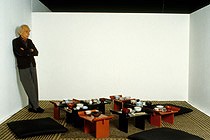
© Wilfried Krüger |
|
Bernard Rudofsky Biography Bernard Rudofsky Further Biographies Detailed Programme Information: Monika Platzer Tel.: +43 (1) 522 31 15 - 21 Fax: +43 (1) 522 31 17 Email: platzer@azw.at |
| © Architekturzentrum Wien 2026 |
 |
|
|
|
|